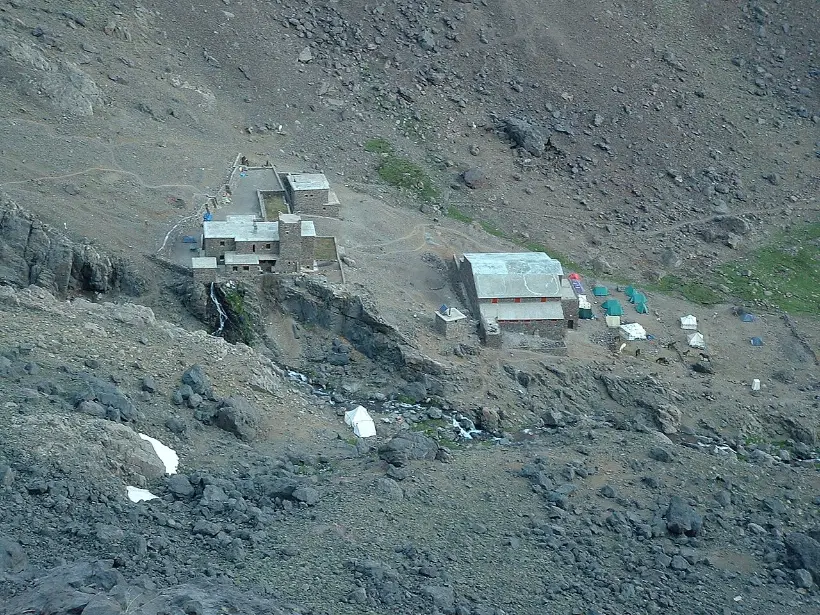
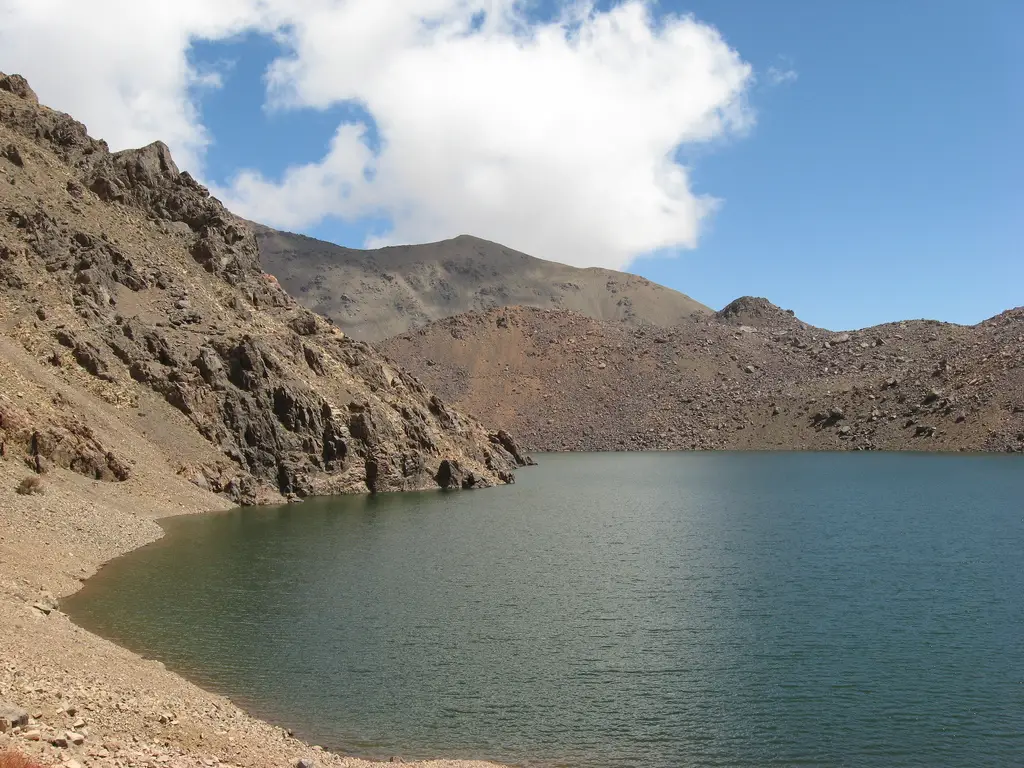
A Lake Ifni trek takes you to a natural high-altitude lake at about 2,300 m, hidden on the southern side of Jebel Toubkal in Toubkal National Park. No road reaches it: you walk in, either in 5–7 hours from the Toubkal refuge over the Tizi n’Ouanoums pass (about 3,650 m), or in roughly three hours from the village of Amsouzart to the south. It is one of the finest stages of the Toubkal circuit.
Key facts
- Altitude: about 2,300 m, on the southern flank of the Toubkal massif
- Origin: a natural dam lake, thought to have formed when a huge rockfall blocked the valley
- Northern approach: Toubkal refuge – Tizi n’Ouanoums – lake, 5–7 h, challenging
- Southern approach: Amsouzart – lake, about 2 h 30–4 h, moderate
- Season: June to October; snow often lingers on the pass into spring
- On site: no services, water must be treated, camping gear essential
Where is Lake Ifni and what is it like?
The lake fills the floor of a deep valley, hemmed in by ochre, grey and rust-coloured scree sweeping down from peaks above 4,000 m. On a sunny day its blue-green water stands out vividly against this almost lunar setting. Downstream towards Amsouzart a few trees and cultivated plots appear, and shepherds bring their flocks to the shores in summer.
Lying within Toubkal National Park, it is one of the few large natural lakes in the High Atlas, hence its reputation as a hidden gem. People come for the silence, a bracing swim if they dare and star-filled nights.
How do you reach Lake Ifni from the Toubkal refuge?
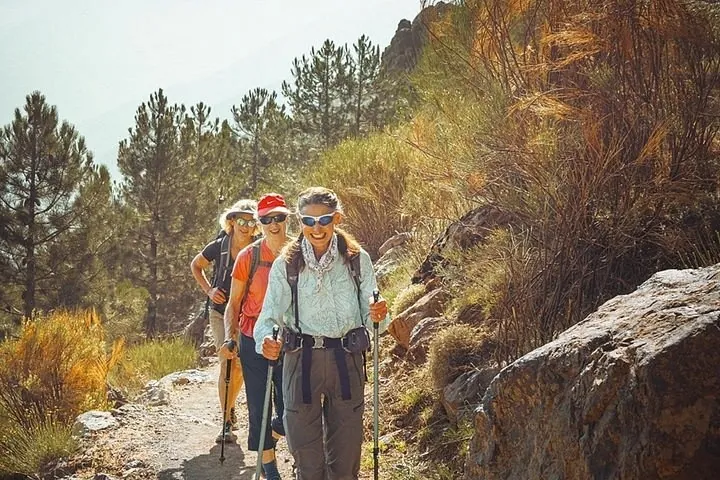
This is the most spectacular route and the one used on the Toubkal circuit. From the refuge (about 3,200 m) you climb a stony side valley to the Tizi n’Ouanoums pass in 2–3 hours, where the view drops away to the lake far below. The descent is long and steep, more than 1,300 m down through loose scree where trekking poles are invaluable, and takes a further 2 h 30 to 4 hours.
It is not technical in summer, but you need strong legs and good acclimatisation. Until late spring the pass can still be snowbound, in which case crampons, an ice axe and experience become essential.
Can you reach Lake Ifni from the south?
Yes, and it is the gentler option. The village of Amsouzart, on the southern slopes, is reached by long mountain roads and tracks: several hours’ drive from Marrakech, best left to a driver who knows the pistes. From there, the path follows the valley past terraced fields, then crosses boulder fields to reach the shore in 2 h 30 to 4 hours, depending on your pace.
This approach suits walkers who would rather avoid a pass above 3,500 m, or those finishing a trek at the lake and heading south to be picked up by vehicle.
How many days do you need to combine Lake Ifni and Toubkal?
Several itineraries work from Imlil:
- 3 days: Imlil – Toubkal refuge; refuge – Tizi n’Ouanoums – Lake Ifni (camp); lake – Amsouzart, then transfer back by vehicle
- 4 days: the same route with the Toubkal summit (4,167 m) on day two before crossing to the lake
- 6–7 days: the lake as part of the full Toubkal circuit trek around the massif
For the climb itself, our guide to climbing Mount Toubkal explains the route from Imlil, the refuge and the difficulty. Summiting before the lake has a clear advantage: you then descend to a lower altitude, which helps recovery.
When is the best season for a Lake Ifni trek?
The ideal window runs from June to October, when Tizi n’Ouanoums is usually free of snow. In high summer the lakeshore is warm by day, but nights stay cool and afternoon storms can build, so start early. September and early October bring glorious light and fewer people. From November to May, the northern crossing becomes a winter mountaineering route; only the southern approach remains realistic, conditions permitting. To fine-tune your dates, see our article on the best time to climb Toubkal.
What should you bring?
- A licensed mountain guide, required for the Toubkal ascent (check current rules) and highly advisable for the pass
- Mules and a muleteer to carry tents, food and luggage
- A tent, a warm sleeping bag and a mat, as there is almost no accommodation by the lake
- A water filter or purification tablets, plus sturdy trekking poles
- Warm layers, a windproof jacket, sun protection and a head torch
- A bag to carry out all your rubbish; no soap in the lake
Read next: Toubkal Altitude Sickness: Symptoms, Prevention and When to Descend
Why stop in Ouirgane before or after the lake?
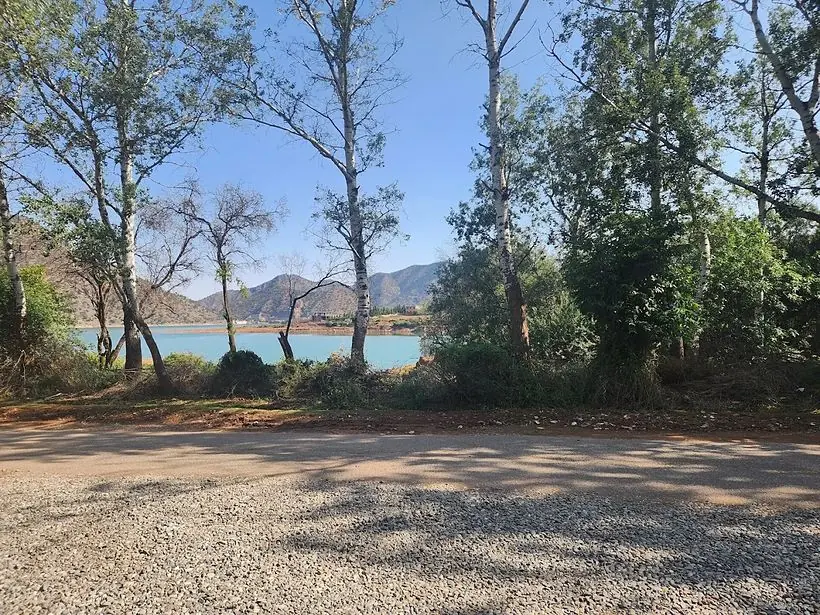
Before heading for the high passes, a night in Ouirgane at around 1,000 m helps you acclimatise gently. Afterwards, you will appreciate the calm of the lake, the auberge’s outdoor pool (spring to autumn) and a home-made tagine after several nights under canvas. Auberge Le Mouflon can arrange your hike with a local guide and a transfer from Marrakech on request.
Ready for your Lake Ifni trek? Book your suite direct with no middleman, or message us on WhatsApp and we will plan the itinerary together.
Frequently asked questions
Can you swim in Lake Ifni?
Swimming is possible in summer for the brave, but the water stays cold even in August and there is no lifeguard. Stay close to the shore, never swim alone and avoid soap or sun cream before getting in.
How long does it take to hike to Lake Ifni?
Allow 5–7 hours from the Toubkal refuge over the Tizi n’Ouanoums pass, or roughly 2 h 30 to 4 hours from Amsouzart in the south. From Imlil, most trekkers plan a three- to four-day trip.
Can you camp at Lake Ifni?
Yes, camping on the shore is common on organised treks, with tents carried by mules. Pitch well back from the water, respect the shepherds and their flocks, carry out all your rubbish and check the current park rules.
Can you drive to Lake Ifni?
No, there is no road to the lake. The nearest point you can reach by vehicle is the village of Amsouzart to the south, from where you still need several hours on foot or by mule.
Good tips from the High Atlas
One letter per season: hikes, Rachida’s recipes and early availability. No spam.